The Shift in Carb Counting: Why Dietitians Want You to Rethink Net Carbs
Walk down any grocery aisle today, and packaged foods promise metabolic freedom. Snack bars, keto tortillas, and protein treats routinely boast "only 2g net carbs," encouraging shoppers to discount total carbohydrates through convenient mental subtraction. Yet the biochemical reality of human digestion rarely aligns with back-of-the-box arithmetic. As outlined in a recent Healthline Report examining whole foods and sustainable fat loss, nutritional quality and metabolic outcomes depend far more on unrefined food matrixes than on engineered dietary deductions.
The skepticism has reached a tipping point. Clinical dietitians and endocrinologists are advising consumers to abandon net carb equations altogether. For decades, the net carb formula functioned as a marketing tool, initially popularized during the low-carb diet booms of the early 2000s. Today, clinicians caution that subtracting non-digestible carbs from total carbohydrate counts creates dangerous blind spots for blood glucose regulation, weight management, and chronic disease care.
📌 Key Takeaways:
- The Regulatory Void: The term "net carbs" has no legal definition under the U.S. Food and Drug Administration (FDA), allowing food manufacturers to apply varying, non-standardized subtraction formulas.
- Variable Glycemic Impact: Functional fibers and bulk sugar alcohols like maltitol produce measurable blood sugar spikes, invalidating the claim that they pass through the gut unnoticed.
- Clinical Guidance: Leading diabetes educators and dietitians increasingly instruct patients to use total carbohydrates for insulin dosing and meal planning to prevent post-meal hyperglycemia.
How the Net Carb Formula Came to Rule the Grocery Aisle
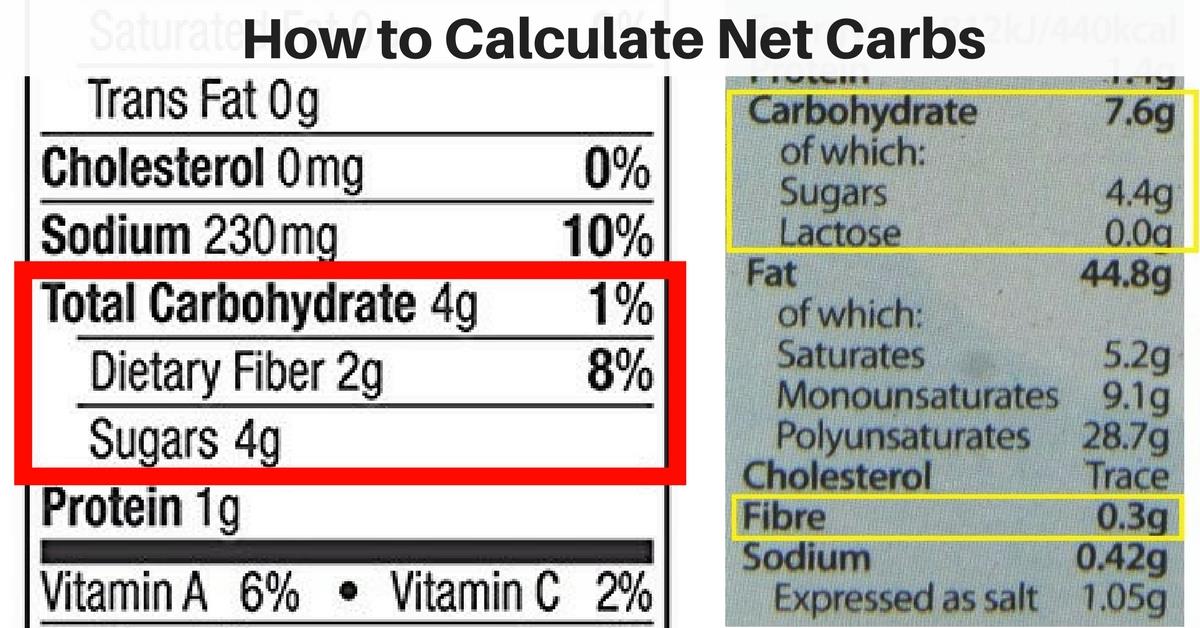
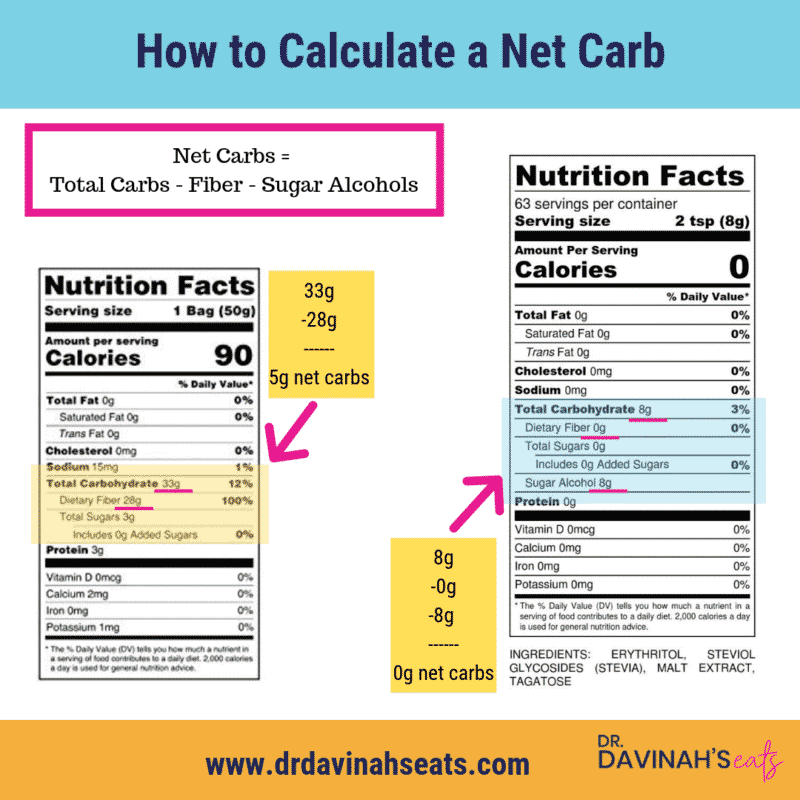
The standard method to calculate a net carb appears straightforward on paper. Consumers find the total carbohydrates line on a nutrition facts label, locate the lines below it, and subtract grams of dietary fiber along with sugar alcohols. In theory, whatever remains represents the digestible carbohydrate fraction that converts into glucose and triggers an insulin response.
UCLA Health clinical documentation notes that standard commercial formulas subtract 100% of dietary fiber and 50% to 100% of sugar alcohols. If an energy bar contains 22 grams of total carbohydrate, 10 grams of dietary fiber, and 8 grams of erythritol, the package prominently advertises 4 grams of net carbs. The equation assumes these subtracted compounds transit the human gastrointestinal tract without contributing glucose to circulation or calories to energy balance.
That assumption breaks down under biological scrutiny. The FDA mandates the disclosure of total carbohydrates, fiber, and total sugars on labels, but the agency does not recognize net carbs as an official metric. Without federal oversight, food manufacturers formulate highly processed convenience items packed with modified starches, brand them as dietary staples for the ketogenic diet, and market them directly to people seeking tight glycemic control.
Why the Minus-Fiber Calculation Fails Human Digestion
The primary flaw in the net carb equation lies in treating all dietary fiber as biologically inert. Insoluble fiber, the structural cellulose found in wheat bran and vegetable skins, moves through the digestive tract largely intact without contributing usable glucose. Soluble fiber behaves completely differently.
When soluble fibers reach the colon, resident bacteria ferment them into short-chain fatty acids (SCFAs), including acetate, propionate, and butyrate. Through hepatic gluconeogenesis, the human liver converts a portion of these fatty acids into glucose. Rather than yielding zero energy, soluble fiber delivers approximately 1.5 to 2.5 calories per gram. Subtracting every fiber gram across the board immediately distorts the caloric and metabolic tally.
Modern ultra-processed low-carb foods compound this error through novel functional fibers. Commercial bakeries use manufactured soluble corn fiber, modified wheat starch, and isomaltooligosaccharides (IMOs) to bolster fiber numbers. Human trials show that several synthetic fibers digest partially in the small intestine, producing substantial blood sugar spikes despite appearing as "zero net impact" dietary fiber on the label.
The Sugar Alcohol Dilemma: Erythritol, Maltitol, and Allulose
Polyols, commonly known as sugar alcohols, present an even greater clinical problem. Food marketers treat all polyols as interchangeable deductions, but their glycemic index scores vary dramatically across the chemical spectrum.
Maltitol, the most widespread bulk sweetener in commercial sugar-free chocolates and snack bars, has a glycemic index between 35 and 52. For perspective, table sugar sits around 65. Maltitol digests partially into sorbitol and free glucose, causing significant blood sugar spikes and requiring active insulin management. Deducting maltitol from total carbohydrates gives consumers a false sense of security while driving postprandial glucose higher.
| Carbohydrate Source | Glycemic Index (0, 100) | Caloric Yield (kcal/g) | Metabolic Behavior & Subtraction Accuracy |
|---|---|---|---|
| Table Sugar (Sucrose) | 65 | 4.0 | Rapidly absorbed. Standard reference carb. |
| Maltitol Syrup | 35, 52 | 2.1, 3.0 | High absorption. Subtracting full amount causes major glucose spikes. |
| Sorbitol / Xylitol | 9, 13 | 2.4, 2.6 | Moderate fermentation. Deducting half provides a safer clinical estimate. |
| Erythritol | 0, 1 | 0.2 | Absorbed in small intestine, excreted in urine. Negligible glycemic rise. |
| Allulose | 0 | 0.4 | Rare sugar. Excreted mostly intact without raising blood glucose. |
Conversely, erythritol and maltitol sit at opposite metabolic extremes. Erythritol has an index near zero because the small intestine absorbs it directly into the bloodstream before the kidneys filter it unchanged into urine. The sweetener does not elevate glucose or insulin, making its deduction mathematically defensible.
The allulose impact presents another regulatory nuance. Allulose is a monosaccharide, chemically classified as a rare sugar. Because human enzymes cannot break down its carbon bonds, over 70% of ingested allulose exits the body via urinary excretion. The FDA allows food brands to omit allulose from "Total Sugars" and "Added Sugars" lines, yet it still must be listed under total carbohydrates. Calculating its impact requires reading ingredient decks line by line.
Clinical Realities in Type 1 Diabetes and Ketogenic Diets
For individuals practicing strict type 1 diabetes management, mathematical inaccuracies around net carbs carry immediate physical dangers. Clinical reporting published by diabetes education group Beyond Type 1 confirms that bolusing insulin based purely on net carbs frequently causes postprandial hyperglycemia. If an individual doses insulin for only 4 grams of advertised net carbs on a 30-gram total carbohydrate keto item, uncounted functional fibers and polyols can drive blood glucose into double-digit elevations over the subsequent four hours.
The standard carb counting method established by the American Diabetes Association (ADA) offers a more defensive calculation. The ADA recommends that if a food contains more than 5 grams of dietary fiber or sugar alcohols, the patient should subtract only half of that amount from the total carbohydrates before administering rapid-acting insulin. This conservative adjustment prevents insulin under-dosing while accounting for partial digestion.
Individuals following a strict ketogenic diet encounter similar frustrations. Many consumers experience weight-loss plateaus and exit ketosis unexpectedly despite consuming foods labeled under 20 grams of net carbs daily. Highly processed keto-friendly foods, such as low-carb ice creams and packaged snack chips, rely on heavy concentrations of modified plant fibers and polyols that stress gut microbiota and generate unexpected hepatic glucose production.
Why Nutrition Experts Are Moving Back to Total Carbohydrates
Dietitians are urging consumers to step away from label math and return to assessing whole-food carbohydrate quality. In an extensive analysis reported by TODAY.com, registered dietitians pointed out that net carb tracking creates an artificial green light for ultra-processed foods. When individuals focus exclusively on net carb totals, they often replace nutrient-dense carbohydrates, such as lentils, berries, and root vegetables, with industrially formulated bars and flour substitutes designed to exploit labeling loopholes.
Whole plant foods contain intrinsic fiber networks that slow gastric emptying, moderate glucose absorption rates, and feed beneficial gut flora without requiring chemical additives. A medium apple contains 25 grams of total carbohydrates and 4 grams of natural fiber. The fiber is physically woven into the cellular walls of the fruit, naturally damping the insulin response. An ultra-processed snack bar containing 25 grams of total carbohydrates with 21 grams of added synthetic corn dextrin functions very differently inside human tissue.
Focusing on total carbohydrate intake simplifies daily meal choices. By eliminating the need to cross-reference polyol absorption coefficients and synthetic fiber types, individuals make choices based on real metabolic demand. Metabolic health improves through eating less processed food, not through creative subtraction on an ingredient panel.
Frequently Asked Questions (FAQ)
Q1: What is the classic formula used to calculate a net carb?
The traditional formula is: Total Carbohydrates minus Dietary Fiber minus Sugar Alcohols equals Net Carbs. However, this equation oversimplifies digestion because certain sugar alcohols and manufactured fibers are partially absorbed and convert into glucose.
Q2: How should someone with diabetes adjust carbohydrate counts for sugar alcohols?
The American Diabetes Association recommends subtracting only half the grams of sugar alcohols from the total carbohydrates if the serving contains more than 5 grams of polyols, unless the sweetener is pure erythritol, which does not raise blood sugar.
Q3: Does allulose count toward total carbohydrates on current nutrition labels?
Yes. The FDA requires allulose to be counted in the total carbohydrate line on the Nutrition Facts label, but it is excluded from "Total Sugars" and "Added Sugars" because it contributes virtually zero calories (0.4 kcal/g) and does not increase blood glucose levels.
Evaluating Your Carbohydrate Strategy for 2026
Net carb math offered an appealing shortcut during the initial wave of ketogenic dieting, but clinical evidence and everyday metabolic tracking have revealed its shortcomings. Packaged food formulations continue to grow more complex, blending novel fibers and proprietary sweetener blends that defy neat back-of-the-envelope formulas. Treating every non-sugar gram on a nutrition panel as metabolically invisible invites blood sugar instability and digestive distress.
Achieving stable glycemic control and sustainable weight management does not require intricate arithmetic. Prioritizing minimally processed whole foods, monitoring total carbohydrate intake, and treating "net carb" claims on packaged labels as marketing rather than metabolic law remains the most reliable path toward long-term metabolic health.